While waiting for the new figures, find the old ISAF statistics here
Over the last year, ISAF had provided each month statistics on security related incidents in Afghanistan, called Monthly Trends. In January this year, these statistics disappeared from the ISAF website, leaving no explanation but just a This page is not available. note (see above). And yesterday, the AP reported that there indeed had been a reason to pull the metrics from ISAF’s internet presence – in a nutshell: the figures were wrong. Taliban attacks not down after all, the wire story read, quoting a spokesman for the military alliance that the advertised 7 per cent decline was, uhm, way beyond the mark: In fact there was no decline at all, officials said.
The main reason for the wrong figures, obvoiusly, was the wrong integration of green reporting, not correctly counting the attacks on Afghan National Security Forces while attacks on ISAF forces went down. (For that reason, the German armed forces had to correct their statistics in January, admitting that instead of a decline the numbers had been the same.) weiterlesen
After two years’ trial, Somali pirates get prison sentences in Hamburg
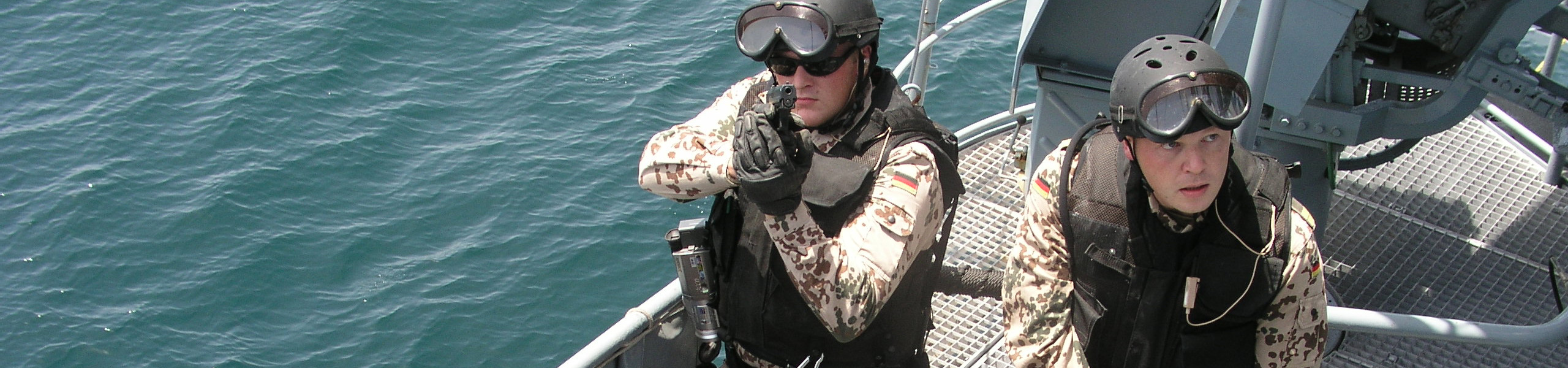
It should have been an easy case. More than two years ago, a gang of armed robbers captured a merchant vessel in the Indian Ocean. Before they could take the crew hostage, the seamen hid in a safe room, stopped the engines and called fort help. And help came swiftly: a few hours later, heavily armed soldiers fast roped from a helicopter, re-took the vessel and arrested the pirates.
What happend on Easter Monday, April 5, 2010, on the German-flagged MV Taipan off the Somali coast, however, turned out a judicial nightmare for the district court in Hamburg, Germany. After almost two year’s trial, the court handed down the verdicts today: seven pirates got six to seven years in prison; the three others, considered minors at the time of the attack, got three years as juvenile delinquents.
During the trial, the first against pirates in this German port since since Klaus Störtebeker hundreds of years ago, a First World judicial system met Third World defendants. It startet with the usual routine of finding out date and place of birth – but the answers, typically during the rainy season and under a tree didn’t quite match the standards of Western court proceedings. As three of the indicted Somalis probably were minors at the time of the attack, their exact age had to be found out: one of the defendants understood the examination in a German hospital with an x-ray machine, according to Germany’s weekly Der Spiegel, as a prelude to swift execution.
Misunderstandings like these were abundant, weiterlesen
Meet a juicy story: The German Spy Ship off Syria
We journalists know what it takes to write a juicy story. Use strong words, like spy ship. Combine them with ongoing events the world is looking at, like what is going on in Syria. Include German intelligence services aiding the Syrian rebels, and here it is: Germany is helping Syrian rebels by providing them with information gathered by a German navy vessel off the coast of Syria, a newspaper said on Sunday, without citing sources.
Now,there are some minor flaws to this story. When it was published on Sunday, Aug. 19, neither the mysterious spy ship nor one of its two sister ships had been in the vicinity of the Syrian coast for at last two months. In fact, the Oker, an Oste class fleet service ship, had entered the Mediterannean from the Straits of Gibraltar just a few days ago, having left its home harbour of Eckernförde on the Baltic on August 8. Since August 17, the Oker had been berthed in the port of Cagliari on the Italian island of Sardinia, which it left for an unknown destination on August 20. (It’s sister ship Alster is currently in the docks for maintenance, while the other ship Oste is in its home port Eckernförde.)
Flottendienstboot “Oker” on the River Elbe (file photo May 2009, Foto Gunnar Ries via flickr , CC-BY-NC-ND-License)
Even if you don’t believe the German Fleet Command saying so, you could check this. By looking at Oker‘s AIS signal on marinetraffic.com.
Well, and what’s this magic mystery ship anyway? It’s an intelligence gathering platform, using electronic, optoelectronic and optic sensors for, well, intelligence gathering. (Originally, these ships were built during the Cold War, operating along the bloc lines in the Baltic Sea.) These ships are unarmed and designed to stay out of harms way, if possible. If the claim is true that a ship with a sensor at maximum height of 20 meters above sea level is able to pick up signals 600 kilometers inland, is a question physicists have to decide.
Indeed, there’s truth to one point: weiterlesen
A fighter pilot, well versed with media and politics: Meet the new ISAF spokesperson
German brigadier general Günter Katz took over as ISAF spokesperson today – the third German in a row to take this position, but the first German Air Force officer serving as a spokesman for the international forces in Kabul. He’s off to a bumpy start, with the much noted Taliban attack on a hotel outside the Afghan capital, and he’s off to a tough year with troop drawdowns and the logistic nightmare of transporting thousands of tons of military material back to the nations.
Now, Katz is used to the fast lane – the 49-year old has spent most of his service years as a fighter pilot, flying the ageing F4-F Phantom as well as the Eurofighter Typhoon.
Günter Katz in front of an Eurofighter Typhoon with the Jagdgeschwader (fighter squadron) 73 “Steinhoff” in Laage, Northern Germany (2006 file photo courtesy JG73)
After joining the Bundeswehr, the German Armed Forces, in 1982, Katz took up pilot training before flying the Phantom for ten years with the Luftwaffe’s Jagdgeschwader 71, named Richthofen after the WWI flying ace. Following general staff training and two years on the staff of NATOS’s HQ AIRNORTH, he had his first foray into the Ministry of Defence, working on politico-military affairs.
In the Ministry, Katz joined the media staff in 2003, amidst the sometimes controversial introduction of the Eurofighter Typhoon into the German Air Force, having to answer critical questions on the new weapons system. That experience came handy in 2004, when Katz took over as Kommodore (squadron leader wing commander) of Jagdgeschwader 73, the unit responsible for the Typhoon introduction. In 2007, he returned to the Ministry, focusing on politico-military affairs again.
Katz was born in Wiesbaden, Germany and is married with two sons. During his deployment he will turn 50 in late August.
ISAF engages in another Twitter war
Here we go again: It’s not the first time that ISAF tries to counter insurgents’ claims by responding to them – on Twitter. There have been a few engagements been already, quickly dubbed Twitter war by the media. Today’s encounter is another example:

Thomas Wiegold schreibt über die Bundeswehr, über Verteidigungs- und Sicherheitspolitik. Die Truppe hat er schon lange im Blick: 1993 berichtete er aus Somalia und seitdem aus fast allen Einsatzgebieten der Bundeswehr.

