Kampfjet schießt vermutlich russische Drohne über Rumänien ab (Neufassung)
Über dem rumänischen Hinterland ist am (heutigen) Freitag ein unbemanntes Flugzeug abgeschossen worden, vermutlich eine russische Shahed-Drohne. Dem Piloten eines rumänischen F-16-Kampfjets gelang der von der NATO angeordnete Abschuss, nachdem ein vorheriger Versuch eines italienischen Eurofighters erfolglos geblieben war. Die Drohne war mehr als eine Stunde im Luftraum des NATO-Landes unterwegs.
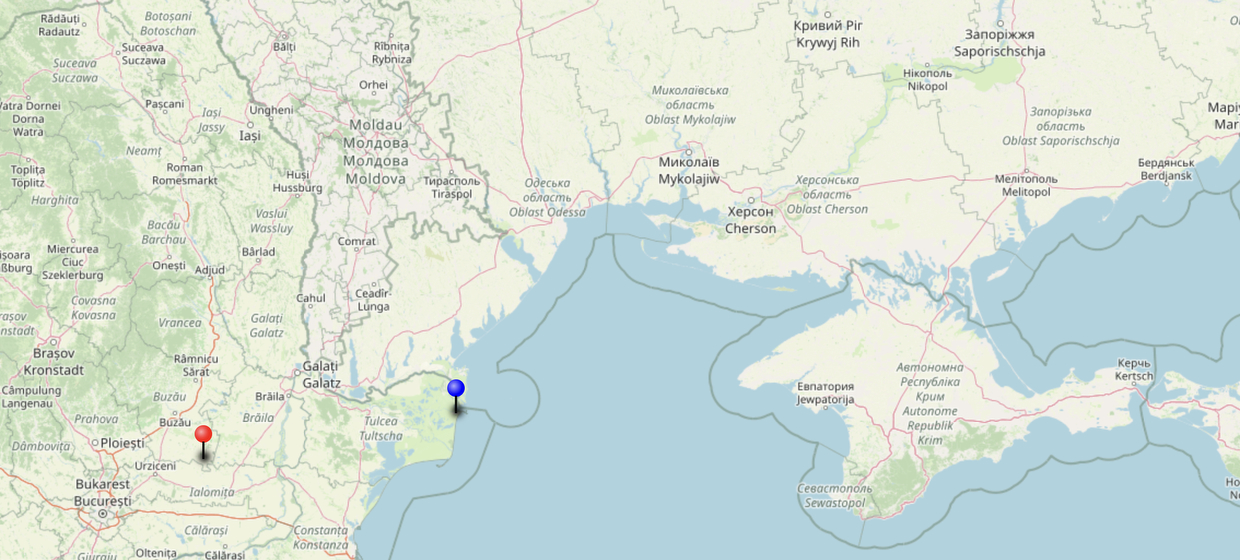
Das unbemannte Flugsystem wurde nach Angaben des Verteidigungsministeriums in Bukarest um 09.39 Uhr Ortszeit (08:39 Uhr MESZ) östlich des Küstenorts Sulina erstmals aufgefasst (auf der Karte oben blau markiert). Um 11.02 Uhr Ortszeit wurde die Drohne von einem F-16-Kampfjet der rumänischen Streitkräfte in der Nähe des Dorfes Padina (auf der Karte rot markiert) abgeschossen.
Aus der Mitteilung des Ministeriums:
Drone Neutralized by Romanian Air Force Pilot in National AirspaceAn F-16 fighter aircraft of the Romanian Air Force, assigned to the 86th Air Base, Fetești, while conducting an air policing mission to monitor and track an unmanned aerial vehicle (UAV) that had violated national airspace, engaged the target with an air-to-air missile on Friday, July 24th and neutralized it over an unpopulated area in the vicinity of Padina, Buzău County.
At 09:39, on Friday, July 24th, the radar surveillance system of the Ministry of National Defence detected an aerial target approximately 20 km east of Sulina. The track subsequently penetrated the national airspace, following a trajectory across Sulina–Brăila–Fetești–Buzău.
Two Italian Air Force Eurofighter Typhoon aircraft, deployed to the 57th „Mihail Kogălniceanu“ Air Base conducting NATO Air Policing Service, and two Romanian Air Force F-16 aircraft assigned to the 86th Air Base, Fetești, were scrambled at 09:48, respectively 10:56 to monitor the situation.
The National Military Command Center alerted the General Inspectorate for Emergency Situations (IGSU) and triggered population warning protocols in Tulcea and Brăila Counties, with RO-Alert notifications issued to the public accordingly.
At 11.02, the Romanian Air Force F-16 aircraft engaged the target and shot it down.
Nach Berichten rumänischer Medien erläuterte das Militär in einer Pressekonferenz, dass die italienischen Eurofighter das Ziel zwar ebenfalls identifiziert hatten, ihr Versuch eines Abschusses jedoch erfolglos geblieben war:
Romania’s Chief of Defence Staff, General Gheorghiță Vlad, and Deputy Chief of Defence Staff, Brigadier General Gheorghe Maxim, provided details during a press conference on the operation that resulted in the drone being shot down over an uninhabited area near Padina, Buzău County.
The military commanders explained that the security situation in the Black Sea region had been highly complex since midnight, with Russia launching multiple waves of attacks against Ukraine’s neighboring Odesa region while Romanian authorities were simultaneously responding to an incident involving a coal cargo vessel in the Black Sea. (…)
Initially, two Italian Eurofighter Typhoons attempted to intercept the drone after the engagement conditions were met over Brăila County, west of the Danube River. The missile missed its target.
25 Kilometer weiter sei dann dem rumänischen Piloten der Abschuss gelungen. Der Einsatz wurde vom NATO-Luftüberwachungszentrum (Combined Air Operations Center, CAOC) in Torrejon in Spanien koordiniert, das für den südlichen NATO-Luftraum zuständig ist. Die italienischen Kampfjets sind, rotierend mit anderen Nationen, als Teil des verstärkten Air Policing der Allianz in Rumänien im Einsatz. Bei der Entscheidung für den Abschuss habe eine wesentliche Rolle gespielt, dass das unbemannte Flugsystem über möglichst dünn besiedeltem Gebiet abgeschossen werden sollte.
Nach Angaben des Portals Romania Journal bestätigten sowohl Verteidigungsminister Radu Miruțăals auch das Militär, dass es sich nach ersten Erkenntnissen um eine russische Shahed-Drohne gehandelt habe. Sie gingen davon aus, dass diese Drohne auch eine Gefechtsladung getragen habe.
Das NATO Air Command in Ramstein erklärte, die Drohne sei nach Eindringen in den Luftraum in kurzer Zeit abgeschossen worden:
In the morning hours of 24 July 2026, two Romanian F-16s at Fetești Air Base and two Italian Eurofighters at Mihail Kogălniceanu Air Base scrambled under NATO command and control to identify an unknown unmanned aerial vehicle (UAV) flying close to Romanian airspace.
The drone was promptly identified, and after crossing into Romanian airspace, the NATO assets were cleared to engage. Quickly after, the threat was shot down in Romanian airspace. This multinational combined effort underlines how NATO is ready and able to react to any potential air threats, 24/7, to safeguard our territory and protect our people.
The shootdown comes as NATO, Romania, and other nations actively acquire ground-based interceptors to enhance Allied and national air defence capabilities. Romania, for example, has acquired the MEROPS counter-drone system, which is designed to intercept small unmanned aerial systems.
Vorerst scheint allerdings die Drohnenabwehr an der Südostflanke der NATO weiterhin nur vergleichsweise aufwändig mit Kampfjets und Luft-Luft-Raketen möglich.
(Grafik: OpenStreetMap-Karte von Rumänien und Teilen der Ukraine mit Markierung für Sulina, blau, und Padina, rot)
Letzte Kommentare