
DroneWatch: Kampfjet schießt Drohne im rumänischen Hinterland ab (Nachtrag: NATO)
Im rumänischen Hinterland ist eine militärische Drohne abgeschossen worden – mehr als eine Stunde nachdem sie erstmals über dem Territorium des NATO-Mitglieds auf dem Radarschirm auftauchte. Unabhängig von der – noch offenen – Frage, ob es sich um eine russische oder ukrainische Drohne, fehlgeleitet in den NATO-Luftraum, handelte: Die Zeitdauer, aber auch die Abwehr mittels Luft-Luft-Rakete von einem Kampfjets aus wirft Fragen auf für die Drohnenabwehr an der Ostflanke des Bündnisses.
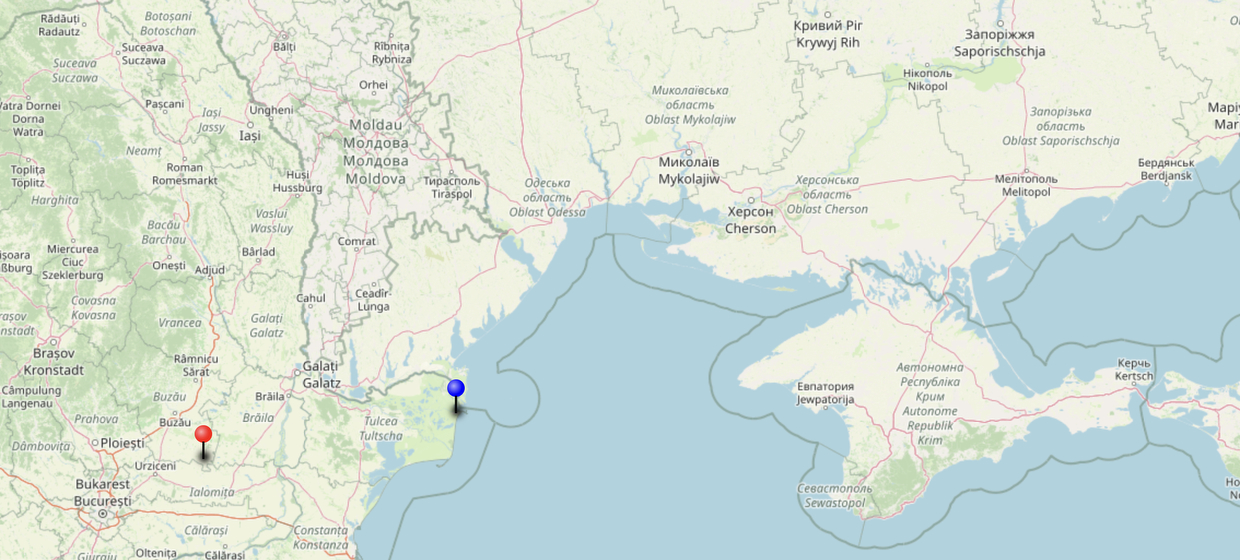
Das unbemannte Flugsystem wurde nach Angaben des Verteidigungsministeriums in Bukarest am (heutigen) Freitag um 09.39 Uhr Ortszeit (08:39 Uhr MESZ) östlich des Küstenorts Sulina (KORREKTUR, nicht über Sulina) erstmals aufgefasst (auf der Karte oben blau markiert). Um 11.02 Uhr Ortszeit wurde die Drohne von einem F-16-Kampfjet der rumänischen Streitkräfte in der Nähe des Dorfes Padina (auf der Karte rot markiert) abgeschossen.
Aus der Mitteilung des Ministeriums:
Drone Neutralized by Romanian Air Force Pilot in National AirspaceAn F-16 fighter aircraft of the Romanian Air Force, assigned to the 86th Air Base, Fetești, while conducting an air policing mission to monitor and track an unmanned aerial vehicle (UAV) that had violated national airspace, engaged the target with an air-to-air missile on Friday, July 24th and neutralized it over an unpopulated area in the vicinity of Padina, Buzău County.
At 09:39, on Friday, July 24th, the radar surveillance system of the Ministry of National Defence detected an aerial target approximately 20 km east of Sulina. The track subsequently penetrated the national airspace, following a trajectory across Sulina–Brăila–Fetești–Buzău.
Two Italian Air Force Eurofighter Typhoon aircraft, deployed to the 57th „Mihail Kogălniceanu“ Air Base conducting NATO Air Policing Service, and two Romanian Air Force F-16 aircraft assigned to the 86th Air Base, Fetești, were scrambled at 09:48, respectively 10:56 to monitor the situation.
The National Military Command Center alerted the General Inspectorate for Emergency Situations (IGSU) and triggered population warning protocols in Tulcea and Brăila Counties, with RO-Alert notifications issued to the public accordingly.
At 11.02, the Romanian Air Force F-16 aircraft engaged the target and shot it down.
Weiterhin scheint damit die Drohnenabwehr der Allianz weitgehend von – vergleichsweise aufwändigen und teuren – Einsätzen von Kampfjets mit ihren Luft-Luft-Raketen abhängig.
Nachtrag: Zur Herkunft der Drohne gibt es bislang keine weiteren Angaben; dafür zieht die NATO eine positive Bilanz dieser Abwehr. Vom NATO Air Command in Ramstein:
In the morning hours of 24 July 2026, two Romanian F-16s at Fetești Air Base and two Italian Eurofighters at Mihail Kogălniceanu Air Base scrambled under NATO command and control to identify an unknown unmanned aerial vehicle (UAV) flying close to Romanian airspace.
The drone was promptly identified, and after crossing into Romanian airspace, the NATO assets were cleared to engage. Quickly after, the threat was shot down in Romanian airspace. This multinational combined effort underlines how NATO is ready and able to react to any potential air threats, 24/7, to safeguard our territory and protect our people.
The shootdown comes as NATO, Romania, and other nations actively acquire ground-based interceptors to enhance Allied and national air defence capabilities. Romania, for example, has acquired the MEROPS counter-drone system, which is designed to intercept small unmanned aerial systems.
(Grafik: OpenStreetMap-Karte von Rumänien und Teilen der Ukraine mit Markierung für Sulina, blau, und Padina, rot)
Letzte Kommentare